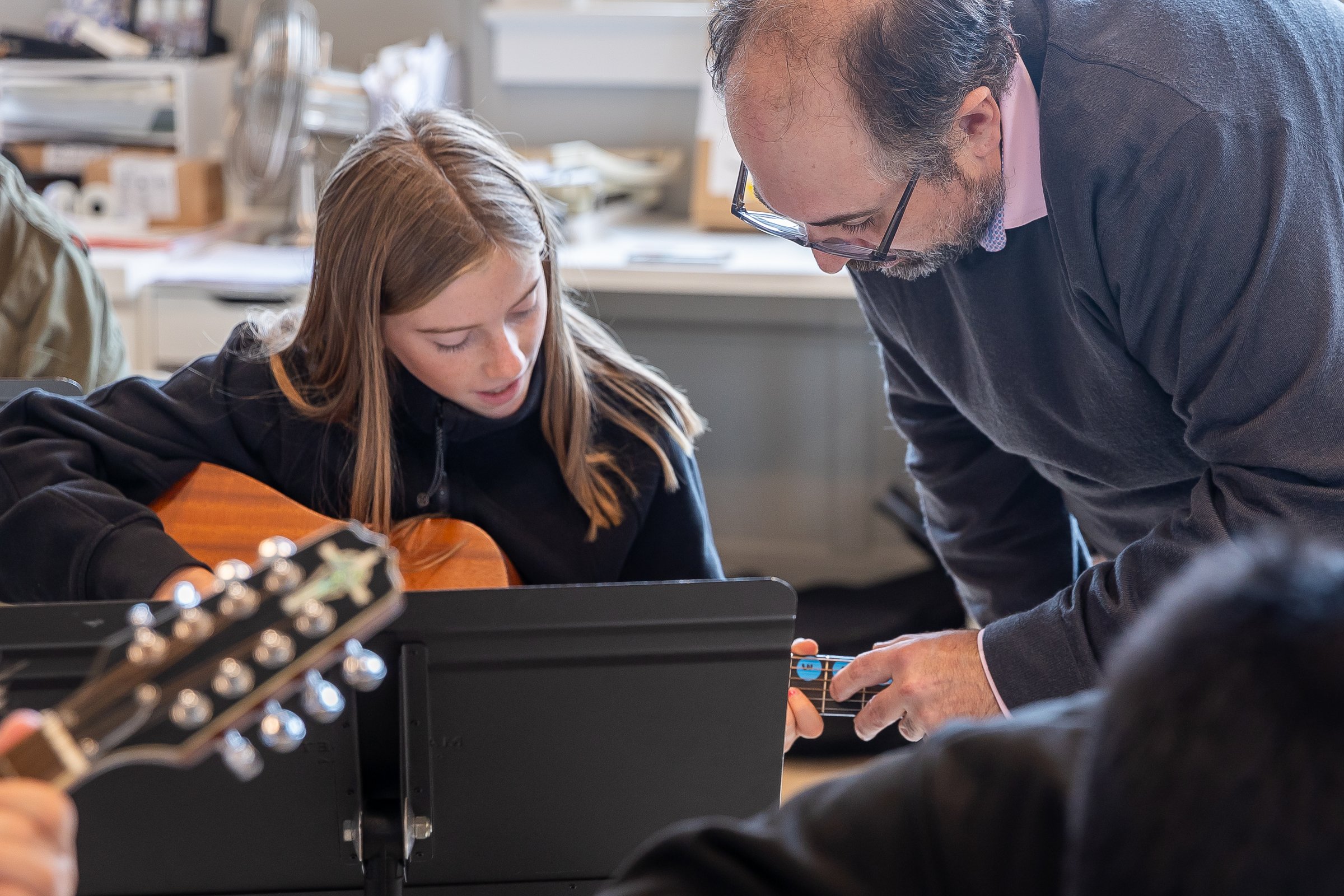
Our goal is not simply to teach children to play music.
Every child enters the music program as a listener.
They leave as a musician.
Along the way, they develop the ability to hear music, read music, perform music, create music, and most importantly, make music with other people.
Each grade has a different role in that journey.
At La Scuola International School, we seek to develop thoughtful listeners, confident performers, creative problem-solvers, and compassionate collaborators. Through nine years of musical study, students learn that music is both a language and a community — one that invites every student to find their voice while learning to listen to the voices of others.
— Carlo Dean, Director of Performing Arts
Kindergarten
Music is a language.
Students discover that music has its own vocabulary.
They sing every day, develop a steady beat, move to music, and begin to hear relationships between pitches through solfège. Rather than beginning with written notation, students first experience music physically and aurally.
They compose simple ideas, improvise, and begin recognizing musical patterns.
By the end of Kindergarten, music is something they can hear, sing, and begin to understand—not merely imitate.
Big idea: I can think musically.
Grade 1
Music becomes visible.
Students begin connecting the sounds they already know with written notation.
Using rhythm syllables, percussion, and drum pads, they develop coordination while learning that symbols represent musical ideas.
Pitch reading expands through glockenspiel and singing.
Students continue composing and performing, gradually recognizing that notation is simply another way of communicating music.
Big idea: Music can be written down.
Grade 2
Reading becomes fluent.
Students become increasingly independent readers.
They expand note reading, rhythm reading, and performance skills while developing confidence performing on barred instruments and percussion.
Composition and transcription become more intentional as students begin recognizing musical structures instead of isolated notes.
By the end of Grade 2, students are prepared to transfer their literacy to a string instrument.
Big idea: I can read music.
Grade 3
Literacy meets an instrument.
Students begin learning the ukulele.
For the first time, they discover that musical literacy allows them to play an instrument rather than memorize songs.
They learn first position, basic chords, accompaniment patterns, melody playing, sight reading, and ensemble skills.
Students begin hearing harmony while performing duets and in small ensembles.
Home practice becomes an important part of musical growth.
By the end of Grade 3, students have developed enough fluency to approach unfamiliar music with confidence.
Big idea: Reading music lets me make music.
Grade 4
Becoming an orchestral musician.
Students enter the Mandolin Orchestra.
Rather than everyone playing the same instrument, students now contribute unique voices on mandolin, mandola, guitar, or bass.
They learn that every part matters.
Students expand their reading skills into multiple clefs and tablature while learning to balance, listen, enter together, and follow a conductor.
Music becomes collaborative rather than individual.
Big idea: My part matters.
Grade 5
Developing musical independence.
Students become more confident ensemble musicians.
Reading becomes faster.
Rhythm becomes more sophisticated.
Students encounter more challenging repertoire requiring expressive playing, phrasing, and stylistic awareness.
Instead of simply following directions, students begin making musical decisions.
They become reliable members of the orchestra.
Big idea: I contribute to the ensemble.
Grade 6
Music has history.
Students begin asking why music sounds the way it does.
Through units exploring practice, migration, and cultural exchange, students discover that music reflects people, movement, geography, and history.
Their repertoire becomes more stylistically diverse while their technical expectations continue to increase.
Performance is no longer only about accuracy… It is about understanding context.
Big idea: Music tells human stories.
Grade 7
Music has structure.
Students begin thinking like musicians rather than simply as performers.
They analyze rhythm, melody, and form while exploring how composers organize musical ideas.
Students compose, improvise, and critique performances with increasing sophistication.
Historical repertoire helps them recognize recurring musical patterns across cultures and time periods.
Big idea: I understand how music works.
Grade 8
Music expresses identity.
Students investigate harmony, improvisation, philosophy, and musical traditions from different cultures.
Rather than asking “How do I play this?” they begin asking “Why was this music written?” and “What does it communicate?”
Students leave the program with the technical ability to perform, the literacy to continue learning independently, and the artistic confidence to participate in musical communities beyond school.
Big idea: Music helps us understand ourselves and others.
About Carlo Dean
Carlo Dean is the Director of Performing Arts at La Scuola International School, where he designed and continues to lead the school’s distinctive K–8 performing arts program. Before La Scuola opened its elementary school, Carlo developed a proposal for a comprehensive music curriculum that reflected the school’s mission and vision. That proposal became the foundation of a program that has grown alongside the school for more than a decade. Carlo continues to build the program in collaboration with students, colleagues, and families.
Carlo believes that meaningful music education begins with relationships. Through trust, collaboration, and shared musical experiences, students develop not only as musicians, but also as thoughtful, hardworking, and effective communicators. While students learn to perform with confidence and artistry, he believes the lasting value of music education lies in the character, curiosity, and sense of responsibility they carry beyond the classroom.
Inspired by La Scuola’s Italian identity and the Bay Area’s rich tradition of plucked-string orchestras, Carlo designed a curriculum centered on the mandolin family of instruments. From classical and folk traditions to film music and contemporary repertoire, students experience music as a living art form while progressing through a carefully sequenced K–8 journey that builds technical skill, musical understanding, creativity, and confidence.
One of Carlo’s favorite initiatives is the Ambassador Ensemble, an auditioned performing group that represents La Scuola throughout the Bay Area. Under his direction, students have performed for Italian President Sergio Mattarella, on the field at Oracle Park before a San Francisco Giants game, at San Francisco City Hall, and at numerous civic and cultural events. These experiences encourage students to see themselves not only as performers, but also as ambassadors for their school and community.
Alongside his work as an educator, Carlo maintains an active career as an arranger, composer, conductor, and performer. His professional work includes arranging for string ensembles and orchestra, conducting recording sessions with Grammy Award-winning producer Joe Chiccarelli, composing music for orchestra, theater, and film, and performing on mandolin and guitar. He earned his Master of Fine Arts in Music from the California Institute of the Arts (CalArts), where he studied composition with James Tenney and Morton Subotnick and received the Betty Freeman Scholarship. He also holds a Bachelor of Music degree from Moravian University.
What Carlo values most about La Scuola is its spirit of collaboration. He believes the strongest schools are built through meaningful relationships among students, teachers, and families. Those relationships make ambitious ideas possible and create traditions that endure. Among his favorites is the school’s anthem, which he composed in collaboration with students and hopes will continue to be sung by generations of La Scuola children for years to come.